arXiv

Read Before You Use

Improving Visual Memory Utilization in Vision-Language Models

Junseok Kim1 Kyungmin Min1 Kyomin Jung1,2†
1IPAI, Seoul National University 2Dept. of ECE, Seoul National University
{kim.junseok, kyungmin97, kjung}@snu.ac.kr
† Corresponding author

Good memory for a VLM agent takes two things: a system that stores and retrieves the right evidence, and a model that can read that evidence and use it. Most work so far has gone into the first. We show the second matters just as much. Today’s VLMs often fail even when the answer is sitting in memory.

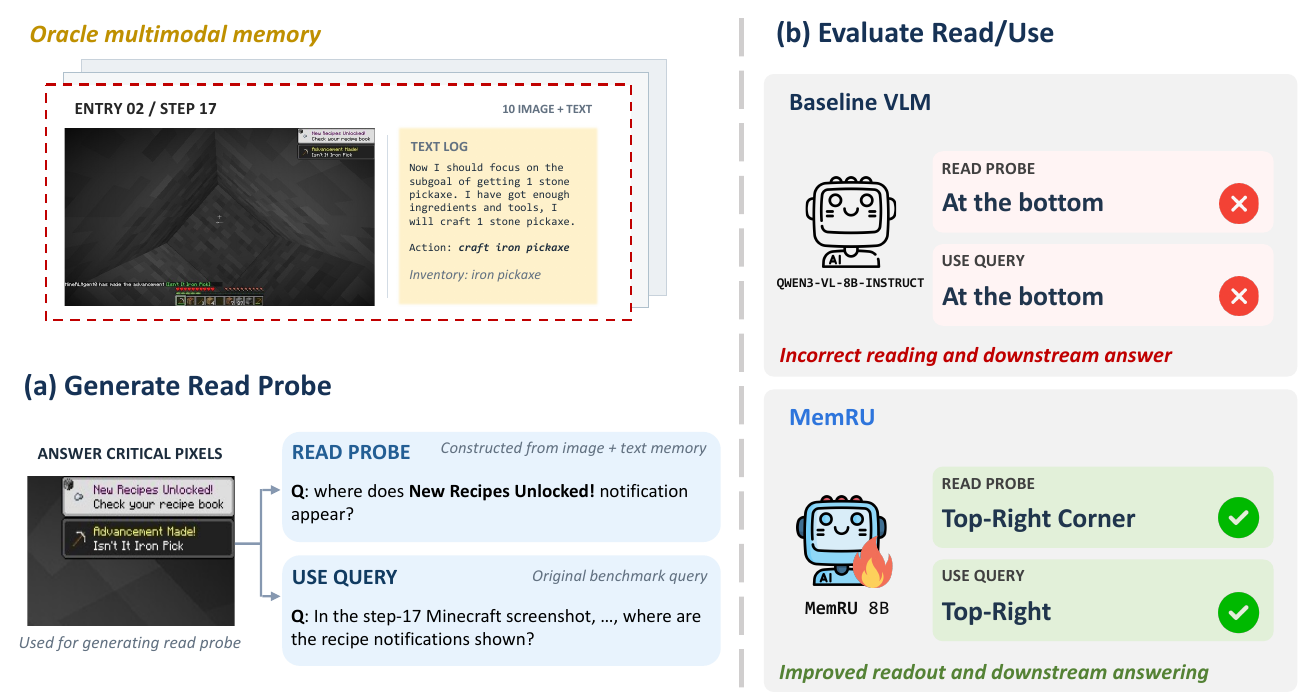
One question from WorldMemArena · Minecraft

In the step-17 screenshot, with the “Isn’t It Iron Pick” advancement visible, where are the recipe notifications shown?

AnswerTop-right
Left: the memory entry for step 17, with the answer-critical pixels (two notifications in the top-right corner) boxed in red dashes, and the read probe and original query built from it. Right: the base Qwen3-VL-8B answers 'At the bottom' to both and is wrong; MemRU 8B answers 'Top-Right Corner' and 'Top-Right' and is right.

The answer is in memory, inside the red dashed box. The base model misreads where the notifications are and gets the question wrong. After MemRU training, the same 8B model reads the pixels correctly and answers correctly.

Observation

Having the evidence is not the same as using it

We kept only questions whose memory was verified to contain the answer. GPT-5-mini still missed 3 in 10.

Then we replaced each memory image with a human-written caption and left everything else alone. Accuracy rose by 19 to 30 points for every model and every memory system. The information was there all along. The models could not get it out of the pixels.
Same memory, two forms: QA accuracy (%)

Answer-sufficient WorldMemArena questions only

Original images Images replaced by reference captions
Show numbers
Observation

Captioning every frame won’t save you

If text works, why not caption every image as it is stored? Because the captioner doesn’t know tomorrow’s question.

Model-written captions kept the answer in only 61–67% of memories and pulled accuracy below raw pixels. Adding captions next to the images didn’t help either. The human captions only worked because they were written with the answer in view.

Accuracy change vs. raw images (pp)

AUGUSTUS memory, Qwen3-VL-4B reader. Raw images score 53.9%.

Diagnosis

Reading and using are two separate failures

For each answer-critical fact we wrote a short read probe (“where does the New Recipes Unlocked! notification appear?”) and checked two things on their own: can the model read the evidence, and does it use it to answer the real question?

About one in five questions fail at reading. Another three in ten are read correctly and still answered wrong. The split barely moves across memory systems, so the bottleneck sits in the model.

Where each question ends up (% of questions)

Qwen3-VL-4B on answer-sufficient memory

Read failure Read, but not used Correct without reading Read and used
Show numbers
Approach

MemRU: teach the model to read, then to use

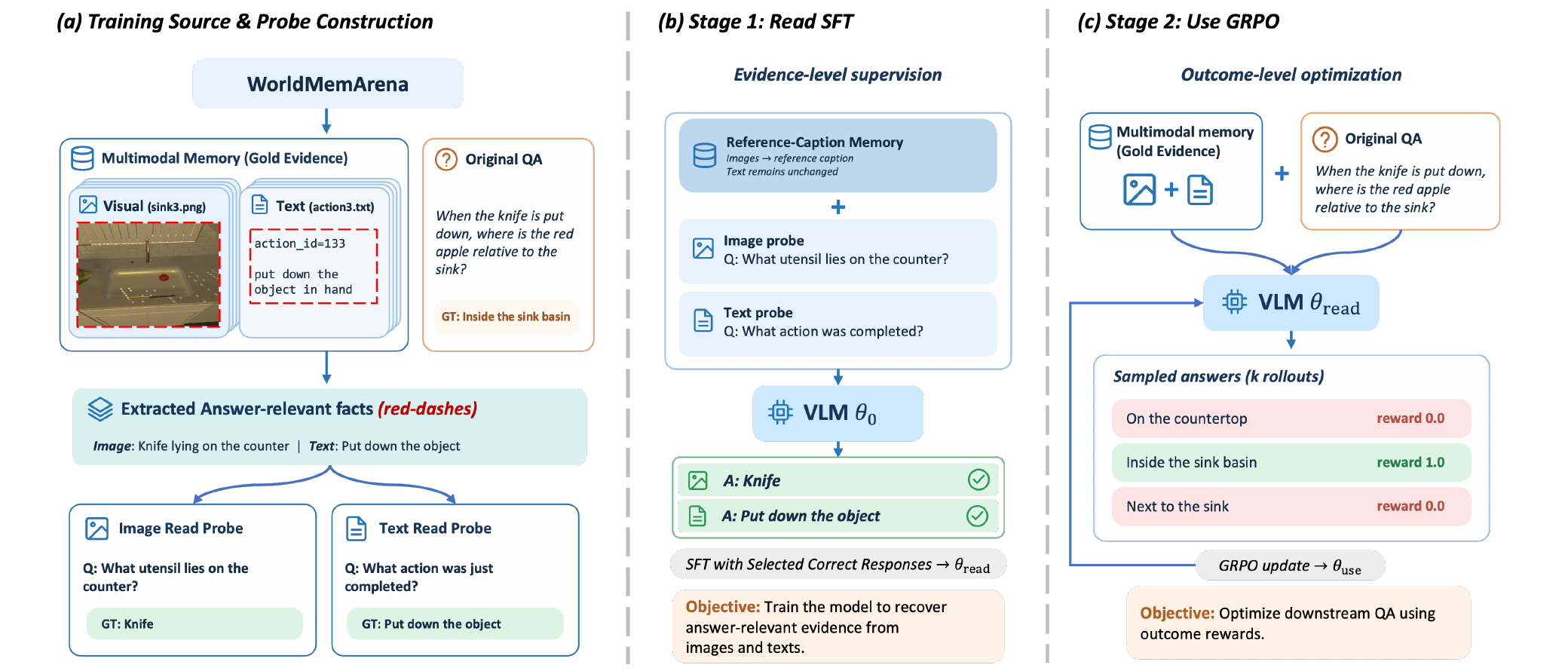
Two failures, two training signals. Read SFT supervises the model on read probes over the original image and text memory, so it learns to pull the evidence out itself. Use GRPO then rewards correct answers to the real questions. The memory system is never touched. Only the reader changes.

MemRU overview. (a) Answer-relevant facts from WorldMemArena gold evidence become image and text read probes. (b) Stage 1, Read SFT: correct probe answers are used to fine-tune the model on the original multimodal memory. (c) Stage 2, Use GRPO: the model samples answers to the original question and is updated with outcome rewards.
60.1 → 69.8
Image read-probe accuracy, Qwen3-VL-8B base → MemRU
67.9 → 79.8
Correct answers once the evidence is read, Read SFT alone → with Use GRPO (8B)
Result

A better reader helps on memory it has never seen

MemRU trains only on WorldMemArena gold evidence. We test it on memories built by three other systems: AUGUSTUS, Omni-SimpleMem and UniversalRAG.

Averaged over them, the 8B model gains 6.7 points over its base, passes Qwen3-VL-32B, and lands within 1.9 points of GPT-5-mini. It is also best overall in three of four settings on MemLens and OpenEQA, two benchmarks it never trained on.

QA accuracy (%) averaged over three unseen memory systems

WorldMemArena test set, 2,073 questions

Show numbers
What we take from this

For memory-augmented VLM agents

Retrieval is not the finish line

A memory system that returns the right evidence has done half the job. Alongside recall and sufficiency, measure how much of that evidence the model turns into correct answers.

Keep the pixels

A caption written at storage time cannot anticipate the question asked later. Model-written captions lost the answer in a third or more of memories.

Train the reader

Reading and using fail separately and respond to different training signals. A model that reads better improved on every memory system we tested, without changing any of them.

Citation

BibTeX

@article{kim2026readbeforeuse,
  title   = {Read Before You Use: Improving Visual Memory
             Utilization in Vision-Language Models},
  author  = {Kim, Junseok and Min, Kyungmin and Jung, Kyomin},
  journal = {arXiv preprint arXiv:2611.33687},
  year    = {2026}
}